

Design history, 1983 to today
From 1983 to Today: How Swatch Keeps Reinventing the Watch
Four decades, one plastic idea, and a habit of asking what a watch could be next.
Why does Swatch never stand still?
Most brands find one good idea and spend decades repeating it. Swatch found one in 1983 and has spent the years since asking what else a watch could be. Sometimes the answer was a colour, sometimes a painting, sometimes a new material or a movement with only 51 parts. The vintage Swatch watches in our shop are the evidence: each one is a snapshot of a moment when the brand changed direction.
This guide walks through those moments, from the first Gent to today's bioceramic and destination editions, and shows what stayed the same underneath. If you collect, or are thinking about starting, it also helps you read a watch's design the way a collector does.
Swatch reinvention at a glance

1983: the first reinvention
Swatch itself began as a rescue plan. Swiss watchmaking was under heavy pressure from cheaper quartz watches, and the industry needed an answer that was not simply a smaller price tag on an old design.
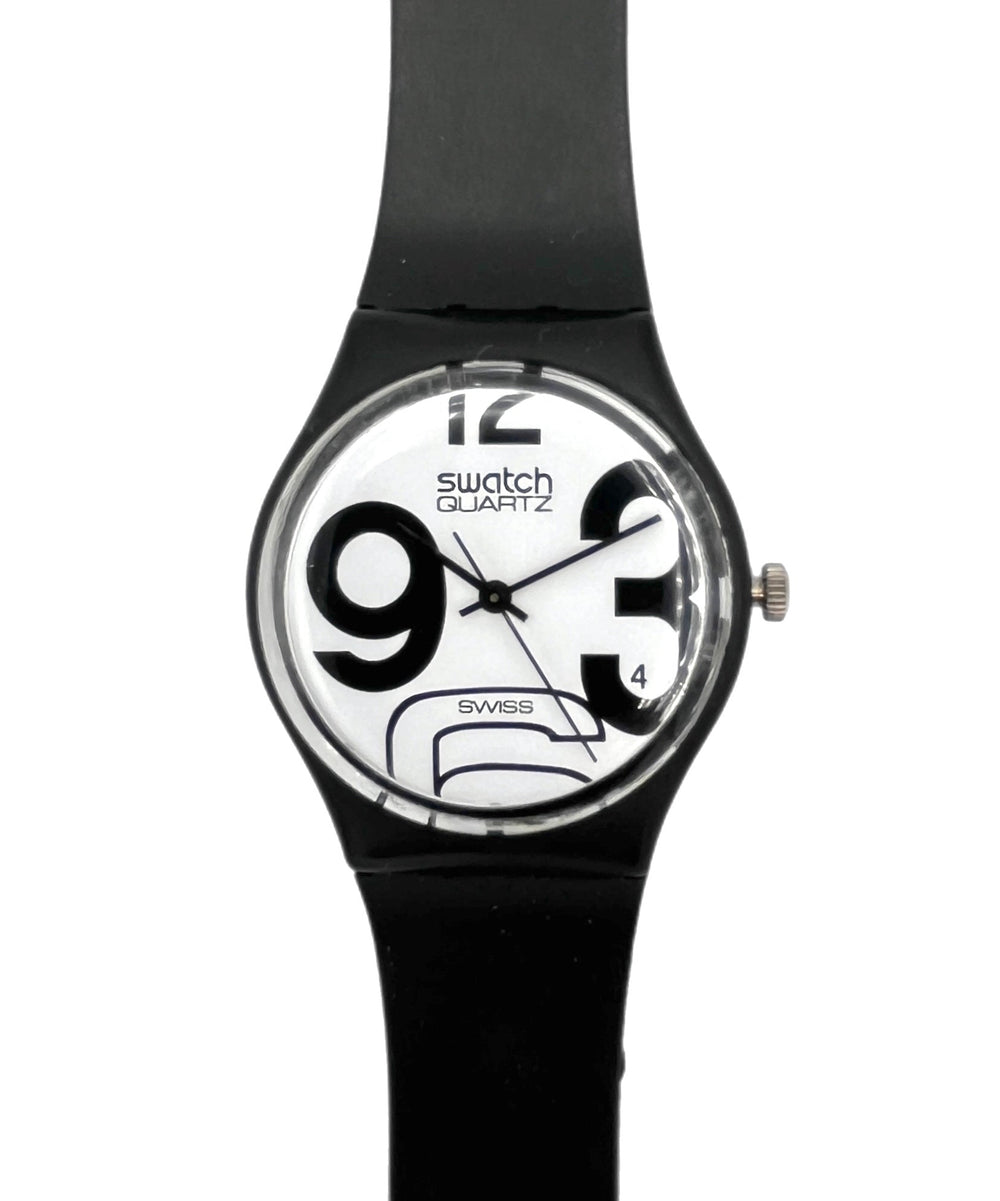
The answer was a plastic watch built from just 51 components, assembled largely by machine and sold at an accessible price. Look at the Gent GB103: black case, black strap and giant numerals doing all the decorating. It is lightweight, graphic and confident.
Reinvention one: the watch as a second watch
The first big shift was psychological. Swatch was presented as an emotional, affordable second watch. You did not replace your serious watch; you added one that matched your mood, your outfit or your week.
That changed how people bought watches. Owning several became normal, new collections arrived like fashion seasons, and the idea of a watch as an accessory rather than an heirloom took hold. It is also the root of today's collector culture, because once you own one, the next one is easy to justify.
A watch for the weekend, a watch for the office, a watch just because it makes you smile.
Reinvention two: the dial as a canvas
If the first reinvention was about price and attitude, the second was about art. Kiki Picasso designed the first Swatch Art Special in 1985, and Keith Haring designs followed in 1986. The dial and strap became a small gallery that fits on a wrist.
The idea never went away. Later artist editions brought painters and illustrators into the catalogue, including these pieces that are well worth a closer look:
 Ishtar by Basquiat2023 · New Gent
 Hollywood Africans2023 · Basquiat
 The Frame by Frida Kahlo2022 · Centre Pompidou series
 The Lady & the Mirror1997 · by Miran Fukuda
You can browse more in the Swatch Art Journey collection or among the Swatch Specials.

Reinvention three: showing the machinery
Swatch also learned to make the inside as interesting as the outside. The 1984 High Tech II GA101 used a transparent case so the movement became part of the design, years before "skeleton" looks were common at the affordable end of the market.
From there Swatch kept widening the toolbox. The early 1990s brought the Chrono and the first Swatch Automatic, proving that a colourful plastic watch could also carry a serious function or a mechanical heart. If you like to see how things work, start with Swatch Chrono and Swatch Automatic.
Swatch through the decades: a timeline of reinvention
Here is the short version of how Swatch has changed the watch, one decade at a time. Each step links to watches in our shop, so you can see the idea in real life.
-
The first Swatch collection launches
A lightweight plastic watch built from 51 components arrives at an accessible price, answering the pressure of cheap quartz with design instead of a discount.
Browse 1983 Swatch Gents -
High Tech II shows the movement
A transparent case turns the mechanism into part of the look, and proves a Swatch can be as interesting inside as outside.
See the High Tech II GA101 -
Kiki Picasso designs the first Swatch Art Special
The dial becomes a canvas, and artist collaborations become part of the brand's identity.
Explore the Swatch Art Journey collection -
Keith Haring designs continue the art idea
Bold, graphic artwork moves from the gallery onto the wrist, and Swatch collecting starts to look like art collecting.
Browse Swatch Specials -
Chrono, Automatic and the ultra-thin Skin
Swatch adds serious function and mechanical movements to its colourful plastic watches, and the Skin of 1997 makes slimness part of the story.
Browse Swatch Automatic · Swatch Chrono -
The Sistem51 rethinks the mechanical movement
An automated, 51-part mechanical movement echoes the 1983 promise of fewer parts and smart production.
See the Automatic Sistem Grid -
Bioceramic arrives, and museum art returns
A new material and a space-inspired collaboration draw huge queues, while the Centre Pompidou series brings painters such as Frida Kahlo to the dial.
See Frida Kahlo's The Frame -
Destination Art Specials turn places into designs
Artists interpret cities and countries on the dial, from Barcelona and Australia to Amsterdam, and collectors rediscover the originals that started it all.
Browse Destination Specials
Reinvention four: new materials and new movements
In the late 1990s the Skin showed that a Swatch could be extremely thin. In 2013 the Sistem51 went a step further: a mechanical automatic movement made of 51 parts, built on an automated line. It echoed the 1983 promise, a lower part count and smart production, applied to a mechanical watch.
Thinner
The Skin made slimness a Swatch trait.
Smarter
Sistem51 rethought how a mechanical movement is assembled.
Greener
Bioceramic blends ceramic with a bio-sourced material for a new feel.
In 2022 bioceramic arrived with a collaboration that sent collectors lining up outside shops worldwide. Whatever your view of the hype, it showed that Swatch could still surprise, even after four decades, by combining a fresh material with a bold partnership.
Reinvention five: collecting places, not just models
The newest chapter treats cities and countries as design themes. Destination Art Specials invite artists to interpret a place on the dial, and they turn a watch into a small travel souvenir. The yellow Grancelona from 2026 and the multicoloured Tirrike from 2025 show how far the dial-as-canvas idea has travelled since Kiki Picasso.


Browse them all in the Destination Specials collection, or see the Amsterdam edition if you want a Dutch connection.
What never changes
For all the new materials and collaborations, a few things have stayed constant since 1983. They explain why a watch from the first year and a watch from last year still feel like family.
Bold, readable design
Strong graphics and clear colour, from giant numerals to full-dial artwork.
Accessible by intent
Swatch keeps design within reach instead of treating it as a luxury signal.
Playful experiments
Every few years a new material, movement or partner resets expectations.
Swatch then and now
| Area | 1980s | Today |
|---|---|---|
| Material | Lightweight plastic | Plastic, silicone, bioceramic and more |
| Movement | Simple quartz | Quartz, automatic and Sistem51 |
| Art | First Art Specials, such as Kiki Picasso and Keith Haring | Museum series and destination editions |
| Buying | Shop windows and new collections | Online shops, drops and vintage specialists |
Summary based on widely published Swatch history; check each product page for the exact specification of a model.
Where to see what Swatch is releasing today
Everything in our shop is vintage or pre-owned, so for the newest launches the brand's own site is the right place to look. The official Swatch website shows current collections, new collaborations and store locations, and it is a handy way to compare a modern release with the older design that inspired it. We are an independent vintage specialist and not affiliated with Swatch, so when you want to own one of those earlier originals, you can always come back and browse our vintage Swatch watches.
Where should you start collecting?
Because Swatch keeps reinventing itself, there is no single right entry point. Pick the reinvention that appeals to you.
You like the founding idea. Start with the GB103 or the Tennis Stripes GW101, or browse 1983 Gents.
You want a dial that works like a painting. Try the Basquiat Ishtar or Frida Kahlo's The Frame, or explore the Art Journey collection.
You like to see how it works. Look at the Automatic Sistem Grid, the transparent High Tech II and Swatch Automatic.
You collect places and recent designs. See Grancelona, Tirrike and the New Gent range.
Why vintage Swatch still matters
Every reinvention left behind watches that tell you something about their year. A vintage Swatch is a small, wearable piece of design history, and many collectors enjoy tracing how one idea led to the next.
When you shop, weigh distinctive design, documented artist collaborations, condition and completeness. Collectible does not mean a rising price, so buy because you love the watch and treat any resale value as a bonus. Before you order, check the photos, the condition description and the model code, and read the shipping policy and refund policy. If anything is unclear, contact us.
Explore Swatch design families
Gent
The classic size and the heart of early Swatch. Browse vintage Swatch Gent
Lady
Smaller cases, same graphic confidence. Browse Swatch Lady
Pop and Scuba
Wearable fun and water-ready style. Pop Swatch · Scuba
Frequently asked questions about vintage Swatch
When was the first Swatch launched?
The first Swatch collection launched in 1983. It was built from 51 components, which kept production simple and the price accessible. See the originals in our 1983 Swatch Gent collection.
How has Swatch reinvented the watch over the years?
Through art collaborations from 1985, chronographs and automatics in the early 1990s, the ultra-thin Skin in 1997, the Sistem51 in 2013 and bioceramic in 2022. Today it also releases destination editions that turn cities into dial designs.
What is the Sistem51?
It is a mechanical automatic movement introduced in 2013, made of 51 parts and assembled on an automated line. You can see one in the Automatic Sistem Grid.
What is the difference between Swatch Gent, Lady and New Gent?
Gent is the classic size and the heart of early Swatch, Lady has smaller cases, and New Gent has larger dials and is often used for art collaborations. Browse Gent, Lady and New Gent.
How do I choose my first vintage Swatch?
Start with the design that appeals to you most: a graphic 1983 classic, an artist edition or a watch with a visible movement. Then check condition, model code and photos on the product page.
Are vintage Swatch watches worth collecting?
Many collectors value original designs, artist editions and good condition. Prices can go down as well as up, so buy a watch because you love wearing it.
Where can I buy vintage Swatch watches online?
Right here. Browse our vintage Swatch watches, where condition and price are listed on every product page.
One idea, reinvented again and again
From the 1983 original to today's art and destination editions, every Swatch answers the same question: what could a watch be? Not sure where to begin? Try the 1983 Gents or the Art Journey collection.

Pop Swatch a 40 ans (1986–2026) : la montre à clip oversize qui a brisé toutes les règles

Pourquoi Swatch a changé notre façon de concevoir les montres

Le tour du monde en échantillons

Swatch sur le radar de la mode mondiale : édition Shanghai Fashion Week

Qu'est-ce qui rend une Swatch vintage précieuse pour les collectionneurs ?